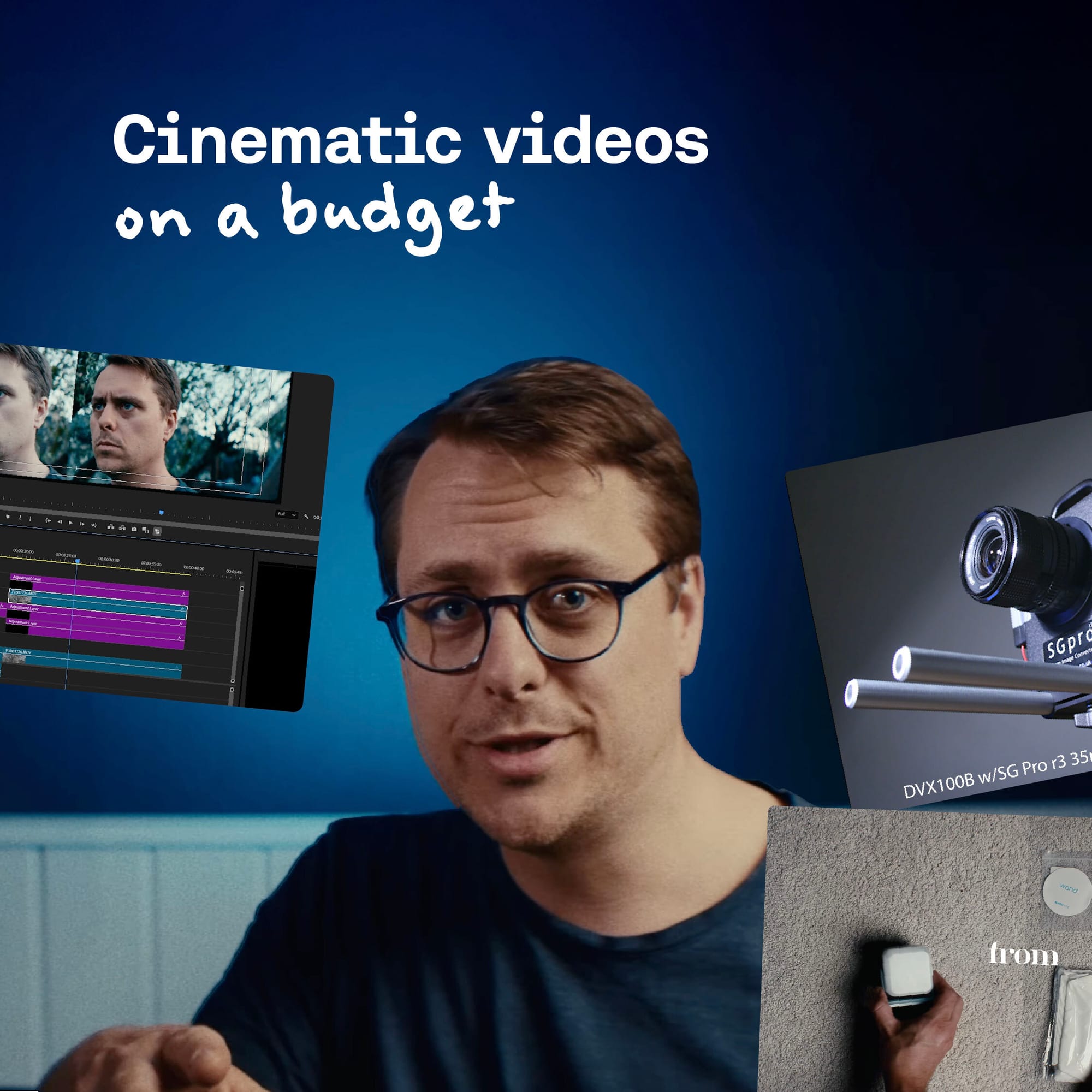
"I had this idea of what cinematic video was – the proper lighting, colors, composition. I thought cinematic meant purely visuals. But getting into the edit of Ruins Ignite, I realized that's not necessarily the case."
Making a sci-fi short film without a big budget sounds like an ambitious project for a solo filmmaker. Tomas Pollen Stavik did it anyway and ended up with a festival-ready film that holds up visually, narratively, and technically. His short film Ruins Ignite was built on a secondhand camera, one lens, and a philosophy about filmmaking that differs from the gear-obsessed advice you might see on your feed.
In this interview with Uppbeat, Tomas breaks down the lessons he learned about making cinematic videos. He explains what cinematic actually means, why limited budgets are a creative advantage, and how the edit is the most powerful tool available to any filmmaker.
Tomas Pollen Stavik is a Norwegian filmmaker and the director of Ruins Ignite, a 2025 short film that's gone on to screen at festivals. He shares his process, from camera tests to color grading, on his YouTube channel, with more of his work available on his personal site and IMDb profile.
- Cinematic is as much your story as your visuals
- You can shoot a film on a phone, but a few rules help
- A low budget forces you to plan better
- The edit is a creative tool, not a cleanup job

1. Cinematic video is about your story as much as your visuals
Many creators assume cinematic automatically means high production value. Tomas used to think the same way and it wasn't until he was deep in the edit of Ruins Ignite that his understanding shifted.
Tomas: "I thought cinematic was purely about your visuals and the right composition. But I learned that it's not necessarily important to have all the technical aspects in order to create something cinematic.”
Once that realization clicked for Tomas, it changed everything. The most expensive shot in the world can't rescue poor scene-to-scene flow. Instead, cinematic video was something Tomas had to build through story structure, and his edit became a place where the film held together or fell apart.
Tomas: "Yes, cinematic video needs the right lighting. It needs the right colors and 24 frames per second. But it also needs this other thing that is, I would say, even more important – a story."
This doesn't mean technical choices don't matter. It means they serve the narrative, not the other way around. When you shoot with story in mind, the visuals stop being decoration and start being part of the emotional logic of the film.
Tomas's Key Takeaway:
Before you stress about your lighting setup or color grade, ask yourself whether your story has a clear emotional thread connecting each scene. That connection is what makes something feel cinematic, not the kit you used to shoot it.

2. You can shoot a film with any equipment you have, but a few technical rules help
If story is the foundation of cinematic work, does that mean gear is irrelevant? Not quite. Tomas's view is that you can make a film with almost anything – including a phone – as long as you take a strategic approach to capturing your footage.
Tomas: “Film in 24 or 25 frames per second, with a shutter speed that's roughly double that. If you just have that, I think you get rid of some visual noise, because the right movement is there."
For Ruins Ignite, Tomas used a rig he describes as simple and genuinely affordable. It was a basic setup that came about through necessity, but Tomas made it work.
Tomas: "If you invest in an okay lens that allows you to control the aperture, a wider lens like a 35 to 50mm, and an ND filter for shooting outside – you're very far along. That's basically all I used on Ruins Ignite: a camera, a lens, and an ND filter.”
The point isn't to copy that exact setup. It's that the threshold for a film-quality image is far lower than most people think. Choosing the right frame rate and having control over your exposure can do more for your look than a camera body that costs ten times as much.
Tomas's Key Takeaway: You don't need the latest camera to shoot something that feels like a film. Get your frame rate right, control your exposure, and invest in a decent lens over an expensive body. After that, what's on screen matters more than what's behind the lens.

3. A low budget forces you to plan better – that's an advantage
Tomas has never had unlimited resources to make films, and at this point, he sees that constraint as a positive rather than a flaw. Tight budgets force creative decisions that often improve the final result, because you can't rely on being able to fix problems in post-production.
The most valuable discipline scarcity taught Tomas was planning around what you can actually shoot. He watched too many early projects collapse under the weight of overambitious scripts – locations, complex setups, props and equipment that were simply out of reach.
Tomas: "One of the big lessons I learned, luckily before Ruins Ignite, was to shoot what you can shoot. Plan to shoot what you actually can. Don’t plan and write elaborate stories with fifteen different locations that require a big budget."
This doesn’t mean you should lower your creative ambitions, but instead channel them into what's achievable. A single well-chosen location, shot intentionally, will look better on screen than three locations you didn't have time to light properly. The constraint shapes the story into something that can actually be made.
The same logic applies to the sounds you build a film around. Tomas shared in a recent interview how he cleverly layered Uppbeat sound effects to create original sci-fi audio, rather than searching for something that didn't exist or couldn't be licensed. Working within limits tends to produce more distinctive results.
Tomas's Key Takeaway: Write to your budget, not beyond it. Ambitious stories told simply will always beat ambitious stories told badly. If you're working with limited resources, plan every shoot so that what you need is realistically achievable on the day.

4. Treat the edit as a creative tool, not a cleanup job
There's a well-worn piece of advice in filmmaking: you can't always fix your film in post-production. Tomas agrees, but he'd flip it around. The edit isn't where you go to rescue bad footage. It's where you shape the film, kill the shots that slow it down, and find the version of the story that actually works.
Tomas: "Editing is a skill. There's this idea within editing called 'kill your darlings.' I had some shots in Ruins Ignite that I really liked but that didn't make the final cut. I tried removing them and found that the flow was better."
Letting go of footage you're proud of is one of the harder creative habits to build. But it's also one of the most powerful. When a shot doesn't serve the story, it costs the viewer's attention, no matter how good it looks. Tomas found that cuts he was resistant to make were often the ones that improved the film most.
Editing doesn’t cost much beyond time, which makes it a real equalizer for low-budget filmmakers. A clear, decisive post-production process can make up for the resources you don’t have on set. That’s exactly what happened with Ruins Ignite – the version that went to festivals was shaped just as much in the edit as it was on the shoot.
For Tomas, quality music and sound effects are just as important as making the right cuts in the edit. That means having quality audio you can actually use. You can read more about how he approached the full audio in our earlier interview on how Uppbeat helped save his short film.
Tomas's Key Takeaway: The edit is where your film becomes itself. Be ruthless about removing shots that don't serve the story, even the ones you love. A cleaner cut will always feel more cinematic than a bloated one.

Make cinematic video with what you have available
Tomas's approach to filmmaking on a budget doesn't mean you need to compromise on your cinematic vision. Instead, cinematic videos come about through clear storytelling, prioritising the gear that actually matters, and a strong edit. Once you focus on those key elements, you’ll find your content can stand alongside work made with far greater resources.
One of the quickest ways to make low-budget work feel cinematic is through sound that’s clean, intentional, and safe to use. Uppbeat’s sound effects library and royalty-free music help you build that foundation early, so your edit stays creative instead of turning into licensing admin.