"When I got into making YouTube videos, I had a lot of conversations with creators and always noticed how much they lit me up – how energized I was, how curious I became. That was the starting point for Orbit For Creators."
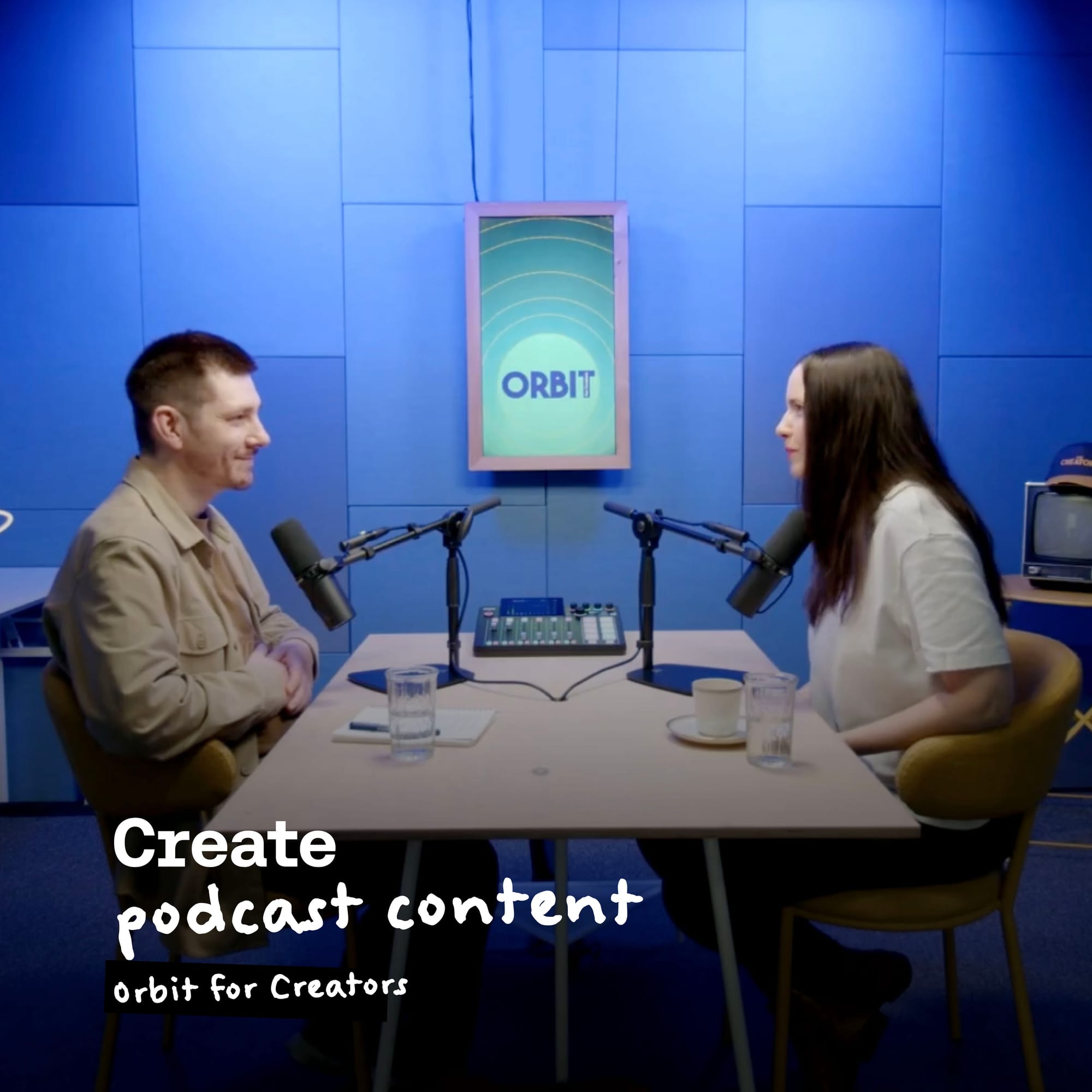
Valentin Farkasch’s favorite part of making content is connecting with other creators. It’s natural then, that he’d start to record these conversations and share them. The result is Orbit for Creators, a podcast built around the messiness of making content brought to you by real creators behind the camera, not just those with millions of subscribers.
In this Uppbeat interview, Valentin shares how he approaches the craft of podcast creation – from picking a format that doesn't drain you and finding guests that pique your interest, to being ruthless in the edit.
Former filmmaker and marketer Valentin Farkasch runs Orbit For Creators, a podcast that explores what it actually takes to succeed as an independent creator today, from getting your first brand deal to building a sustainable business on your own terms. You can find Orbit For Creators on YouTube and Spotify.
- Choose a format that gives you energy
- Know who you're actually talking to
- Select guests based on genuine curiosity
- Research to make conversation flow
- Edit with your video audience in mind

1. Choose a format that gives you the energy to create
Before Valentin launched Orbit for Creators, he tried replicating educational YouTube content he’d seen in his feed. But whilst these formats worked well for other creators, they didn't for him.
VF: "I noticed that making these types of videos felt really exhausting. But when I had conversations with other creators it was the complete opposite.”
The content formats that survive are the ones you can keep showing up for week after week, especially in the early months when growth sometimes feels invisible. For Orbit for Creators, the format itself was something he'd already been doing naturally – talking to people. The show simply became a way to document and share that.
Valentin found a way to focus his energy on the part that actually mattered to him – the conversations themselves. He removed the early friction points that cause most podcasts to stall by interviewing existing creator friends for the first season rather than cold-pitching strangers, and securing a sponsor before launch using contacts from his marketing career. With those two things taken care of, there was nothing in the way of just making the show.
Valentin's Key Takeaway:
Before you commit to a format, ask yourself honestly whether it energizes you or not. If the process of creating feels like a grind from the start, that's a signal worth paying attention to. The format you love to make will always outlast the one that performs well on paper.

2. Know exactly who you're making your show for
Orbit for Creators stands out because Valentin identified an audience that most creator platforms overlook. Instead of building a show about the biggest names in the space, he focused on a much more specific group.
VF: "All the creator education content is based around the million-subscriber-and-more kind of creator. But a very overlooked group of people are the creators in the messy middle.”
The clearer you are about who you're making something for, the easier every other decision becomes – who to invite, what topics to cover, how to frame episodes and market the show.
VF: “My guests know how to make good videos and have a stable audience for the most part, but lots of them are also smaller creators. Or they’ve decided not to game their content in a way that would take them to the ten-million-subscriber range."
This specificity shaped how he thought about sponsorship from the start. With a clear value proposition, Valentin could make a compelling pitch to brands before the show had any subscriber numbers to point to. If you want to go deeper on how Valentin thinks about working with brands as a creator, his guide to getting brand deals is also worth a read.
Valentin's Key Takeaway:
Don't try to make a show for everyone. The more precisely you can describe the person your podcast exists for, the more confidently you'll make every creative decision that follows. Specificity is an asset, not a constraint.

3. Choose guests based on natural curiosity, not a criteria checklist
As Orbit for Creators developed, Valentin started building a structured framework for which guests qualified for the show.
VF: “Instead, I now ask myself if I can learn something from a guest. If I have a natural curiosity about a person our conversations are going to work, sometimes even more so than a guest I thought ticked all the boxes on paper."
This approach has a practical upside too. When a host is genuinely curious about a guest, that energy is audible. Listeners can tell the difference between an interview that's working through a list and one where the host actually wants to be in the room. The result is usually a more honest and revealing conversation – and those tend to travel further.
This is the same approach Kevin E takes to collaborating with other creators. The best creative partnerships start with genuine curiosity about another person's process, not with a calculation about what they can do for your numbers.
Valentin's Key Takeaway:
If you're not genuinely curious about what a guest knows or how they think, this energy will come through in your conversation. Choose guests the same way you'd choose people you'd want to have dinner with – because you actually want to learn something from them, not because their numbers look good on paper.

4. Use research to understand the other person
It's tempting to treat pre-interview research as a way to signal to the guest how many facts you know about their lives. Valentin has found that showing a deeper understanding of who they are works better.
The goal of research isn't to demonstrate how much he knows, but to make the conversation go somewhere real. This means understanding the guest's journey well enough to ask questions that surface things they don't usually talk about.
VF: "What I've learned is that the research element of podcasting is all about relationship-building. It's not just going deep for the sake of it, like 'look how smart I am.' You want to use it as a way of saying that you know them, and get them to open up. That's the purpose of research, to let the other person know that you understand what they've been through."
Valentin has also learned to focus his questions differently from many interviewers. Rather than asking about what someone did, he asks why they made the choices they made, and how it felt.
VF: "I always bring my conversations back to the ‘human element.’ It’s easy to find out the rational reasoning behind your guest’s story. But the emotional layer is where the conversation gets interesting."
It's useful to remember that the facts of someone's journey can typically be found anywhere on the internet. What makes an interview worth watching for your viewers is the process and feeling behind the decisions your guest has made.
Valentin's Key Takeaway:
Research isn't preparation, it's empathy. Go deep enough into a guest's story that you can ask the questions nobody else thinks to ask. Getting them to open up about their feelings and decision-making makes a conversation worth listening to.

5. Edit your podcast like it's a video, not a transcript
What Valentin has discovered making a YouTube podcast is that a recorded conversation and a finished video are not the same thing. The raw conversation is just raw material.
VF: "I have become ruthless when it comes to editing podcast conversations. Ultimately, I create content that should be useful to people. If it's not useful to people, it doesn't need to exist. I learned the hard way that sitting down and having a chat is not good content for the most part."
Valentin's approach is to treat the edit as a standalone piece that doesn’t require context to enjoy. Everything in the final cut needs to earn its place and add to the narrative.
VF: "Basically, it has to be trimmed down. Where usually my chats are about an hour long, I end up with roughly half an hour of finished video, because everything else is housekeeping or little anecdotes that don't need to be in there."
This is the discipline that separates podcasts people actually finish from podcasts that trail off halfway through an episode. The audience's time is precious, and a tight edit is the most straightforward way to respect it.
Valentin's Key Takeaway:
A good conversation and good content are not the same thing. Go into the edit asking whether each section earns its place for someone who has no prior context. If you're making a video podcast, edit it like a video with hooks and visuals elements, rather than simply putting together the transcript of a chat. Ruthlessness is a form of respect for your audience.

Start the show you actually want to make
Podcasting rewards authenticity over calculated, formulaic decisions. Choose the right format, find the right audience, pick guests you're genuinely curious about, and edit so that every shot adds to the overall video. Do these things consistently and you'll build an audience of listeners who show up for every single episode..
If you're thinking about the business side of building a podcast, Valentin's interview on how to get brand deals as a content creator picks up where this one leaves off, including how to make your show attractive to sponsors from the start. And since polished audio is part of what makes a podcast show feel worth backing, Uppbeat's library of royalty-free music for YouTube is a good place to start.