"I want a setup to not get in the way of me recording something. Minimize friction – that's the ultimate goal when building your setup."
Take a look at any good video and you’re likely to find it has a clean background, strong lighting, and steady footage. They’re three things that are simple to achieve in your own content with the right setup – perhaps one similar to the podcast Orbit for Creators.
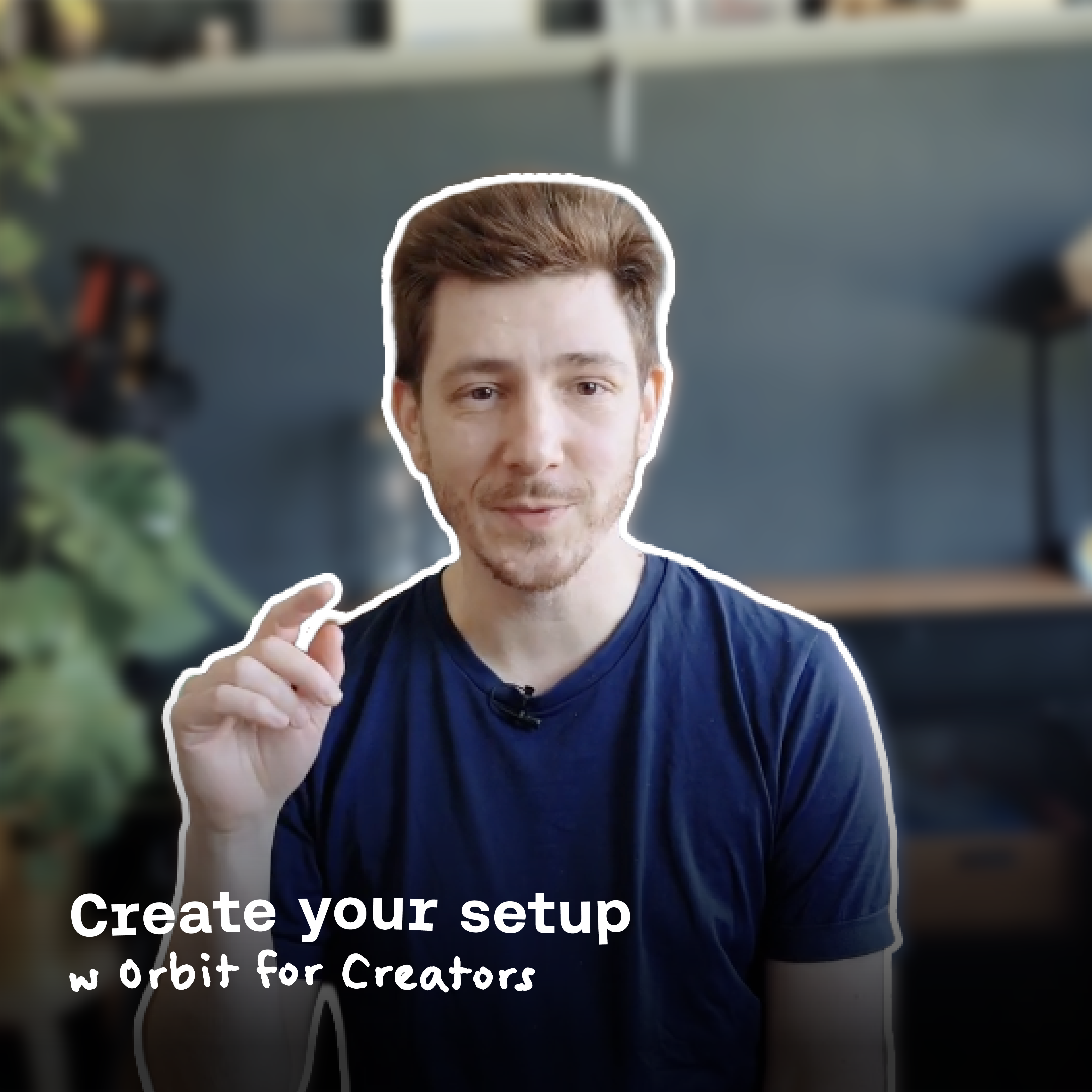
Host Valentin Farkasch knows how to create an effective setup. His podcast is built on candid conversations with creators, giving him a rare window into how other creatives think about their setup. This, plus years spent behind the lens as a photographer and filmmaker, means you can trust him: when Valentin talks about what actually matters in a shot, it comes from real technical grounding.
In this interview with Uppbeat, he breaks down how he thinks about building a setup. You’ll find out what's worth buying, what's worth skipping, and why he'd rather remove something from his setup than add to it.
Former filmmaker and marketer Valentin Farkasch runs Orbit For Creators, a podcast that explores what it actually takes to succeed as an independent creator today, from getting your first brand deal to building a sustainable business on your own terms. You can find Orbit For Creators on YouTube and Spotify.
- Aim for a setup where all it takes is one button
- Buy gear because it solves a problem, not because it's new
- Your background does more for your videos than your camera
- Build depth with light, distance, and color
- Upgrade one pain point at a time
- Let go of polish – 80% is good enough

1. Aim for a setup where all it takes is one button
In Valentin’s experience, a complicated setup can cost you more than just time. Every extra step between having an idea and hitting record is a chance to talk yourself out of filming altogether.
Valentin: "The perfect setup for me is one where you push one button and everything works. I'm close to that state, but there's always something to tinker with."
This target sounds simple, but it rules out a common habit that can lead to an over-complicated setup: treating a new light or lens as the fix for a setup that already does the job. Valentin now trusts the tools he has rather than second-guessing them every time a new option shows up.
VF: "So much of what's online right now is shot on a phone, without even an external microphone, because phone quality has become so good. What I like to do is think about what I can reduce rather than what I can add."
That's a real shift from a few years ago, when you’d likely feel you needed at least a DSLR before you'd published a single video. Valentin's approach shows that you can now skip the spec sheets. He instead asks what's actually slowing him down on a shoot day, then removes it.
Valentin's Key Takeaway:
Aim for a setup that keeps things so simple, you stop thinking about setup at all. If pushing one button gets you recording, everything else is optional.

2. Buy gear because it solves a problem, not because it's new
Years as a working photographer and filmmaker left Valentin with a drawer of equipment bought on impulse and used only once. This kind of spending feels productive in the moment but never touches the actual work.
VF: "Everything I buy now has to really serve a purpose, or fulfill a specific use case. The last camera I bought for my podcast setup isn't the newest – it's not even in production anymore – but the screen flips up instead of out, so I get a better view recording myself."
That single detail, a flip-up screen, was reason enough to buy a secondhand, discontinued camera over something newer and pricier. Simply ask yourself whether any purchase will solve something you've actually run into, or if it just sounds like an upgrade. That then becomes a useful filter to stop you buying kit you don’t need.
VF: "Almost every piece of gear out there is good enough right now – it's really hard to buy bad equipment. As just one example, it's insane how much microphone technology has improved over the last two years – everything is super compact, portable, and easy to use."
That baseline shift matters. When most gear performs equally well, the difference between an average video and a great one comes down to the story you tell rather than the kit you use to tell it.
Valentin's Key Takeaway:
Before you buy anything, name the specific problem you’re looking to solve with new gear. If you can't, it's probably not worth buying.

3. Your background does more for your videos than your camera
This is where Valentin's filmmaking background shines through. Set design is a discipline in its own right in the film industry where whole departments exist just to decide what goes in frame. Valentin applies that same thinking to a setup many creators put little thought into.
VF: "80% of cinematography is set design. You can use the expensive camera, the expensive lens and expensive lights, but if you point it at a white wall, it's going to look like a white wall."
A blank wall gives a viewer's eye nothing to settle on except your face, which gets exhausting to watch over a long video. A few deliberate objects give the eye somewhere else to rest and your space a sense of place.
VF: "I don't have a permanent setup right now, so I'm always fussing over what to put in the background of each video. Small details, like where to put my chair, matter more to me than the cameras I've been using for years."
That order of priorities is telling, especially from someone with years of camera experience. Given a blank slate, the room comes first, and the camera stays exactly the same as it's always been.
Valentin's Key Takeaway:
Spend time on your environment before you spend money on gear. A cheap camera pointed at an interesting space will outperform an expensive one pointed at a blank wall.

4. Build depth in your setup that keeps viewers interested
Once there's something worth looking at in the frame of your setup, you’ll want to ask yourself how it reads on screen. A background can be full of interesting objects and still look flat if there's no separation between you and everything behind you.
VF: "The worst kind of videos are super flat – one person, the same color as the wall. The more shape you can give your shot, the better. I found a dark background works way better for me than a bright one, because I'm very light-skinned. It makes me pop more."
His specific fix (a dark background against pale skin) won't apply to everyone, but the underlying idea does. Ask yourself, does your subject actually separate from what's behind them, or does everything blur into one flat plane? That's where you can use color and contrast to bring life to your setup. From there, you want to create a shot that feels personal to you.
VF: "I love having plants in the background or some kind of natural element that's relatable, more human, and gives a sense of reality."
Plants do two things for Valentin here. They add visual texture without competing for attention, and signal that a real person lives in this space rather than it being a set built purely for the camera.
Valentin's Key Takeaway:
Think in layers rather than one flat frame. Lighting, distance from your background, color contrast, and a few natural objects will do more for depth than any lens.

5. Upgrade your setup one pain point at a time
Once you suspect something in your setup isn't working, it's tempting to overhaul everything at once – new camera, new mic, new lights, all at the same time. Valentin's approach is the opposite: isolate the single biggest bottleneck, fix that, then stop.
VF: "Maybe you're recording on a camera and a separate audio recorder, then combining it all in post – when actually the easier fix is a microphone that plugs straight into your computer."
That's a useful example of how narrow the actual fix usually is. The problem wasn't his whole setup, just one weak link in it, and the solution was a single swap rather than a wholesale upgrade.
VF: "Think about what's actually a pain point for you right now, what's making things more complicated than they need to be – and then upgrade that."
Applied as a habit, this means asking after every shoot what specifically slowed you down, then fixing only that. It's harder than it sounds, because on a bad day several things can feel broken at once – but usually only one of them is the actual bottleneck, and the rest just feel that way because they're annoying you in the moment.
Valentin's Key Takeaway:
Fix the single biggest bottleneck before moving to the next one. Upgrading everything at once makes it impossible to tell what actually made the difference.

6. Let go of perfection – 80% is good enough
Cinematic polish is exactly what a film education teaches you to chase. But Valentin knows how it can work against you on a platform where viewers are watching for a person, not a production.
VF: "I purposefully untrained myself and made things look less polished. I had a sticky note above my desk that said '80% is good enough,' because it's way too easy to keep making something a little nicer, a little more cinematic."
Without that ceiling, there's no natural stopping point. Your ideal setup invites one more pass or tweak. In the meantime, videos stop being made while your setup gets a little more polished.
VF: "Creators stop themselves from making videos because they think they need a big fancy camera and background. What gets them creating again is saying, ‘Screw it, I'm going to use my phone’ and then simply creating one project at a time."
Between a video that's a little rough and a video that gets delayed while the perfect setup is endlessly tweaked, Valentin has clearly picked a side. The sticky note works like a deadline in disguise, forcing you to keep creating before perfectionism gets the final word.
Valentin's Key Takeaway:
Start with a setup that's a little rough but actually gets used. Waiting for a perfect one just delays the work.

The best setup is the one you stop thinking about
Every piece of Valentin's advice comes back to the idea that your setup should serve the content you make. If his no-nonsense approach to gear resonates, filmmaker John Schoolmeesters takes a similarly grounded view in our interview on how to choose the right equipment – worth a read if you're still deciding what's actually worth your money.
Once your visual setup stops getting in the way, you can apply the same streamlined thinking to sound. Uppbeat's music for creators zone is built around pre-cleared tracks you can drop in without a second thought. And if you're piecing together a podcast or interview setup like Valentin's, the podcast sound effects library covers room tone, transitions, and the small details that make a space feel finished.