
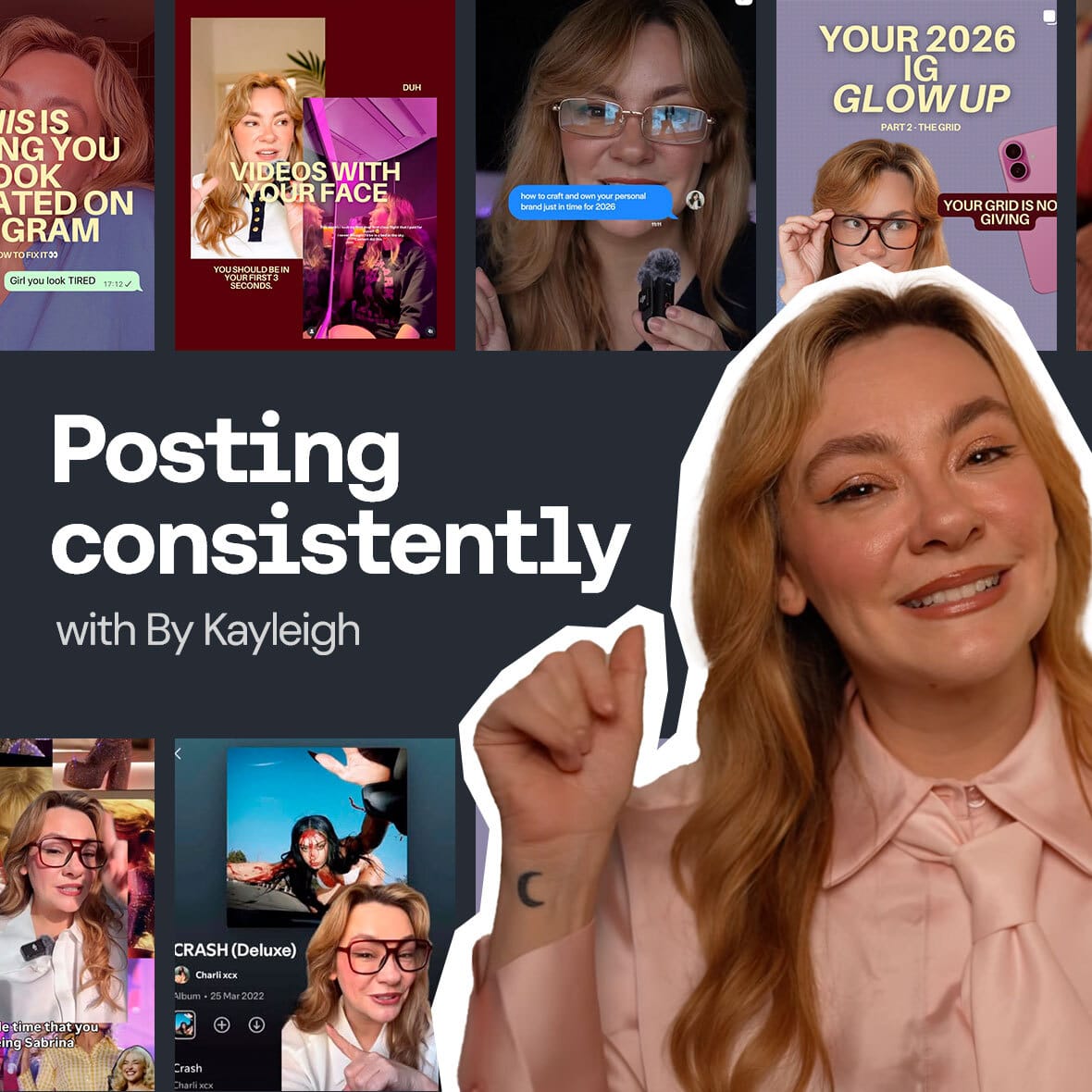
“I try to have a system for everything so that my energy is spent actually creating instead of organizing.”
Kayleigh Keen is always busy. She runs a podcast with over 200 episodes, a YouTube channel of deep-dive celebrity breakdowns, a paid membership and an Instagram account she’s kept going since the app launched. All four are live at once, all four feed the same business, and the only other person involved is her fiancé Robbie, who edits her long-form videos.
From the outside her work ethic might look superhuman, but up close her success is built on a carefully managed system. From time blocking to app management, here’s how she keeps on top of posting consistently, including lessons learned from the batching experiment that backfired and the weekly upload slot she had to give up.
Podcaster, YouTuber, and business coach Kayleigh Keen is the founder of By Kayleigh. She spent years as a working makeup artist and trained separately as a solicitor, before combining both into the business she runs today, helping other makeup artists and content creators. You can find Kayleigh on YouTube and Instagram, and listen to her podcast on Spotify and Apple Podcasts.
- Post messy 100 times before you think about strategy
- Block out your week and let a system do the remembering
- Let each platform set its own rhythm and quality bar
- Create more than you consume
- Remember that consistency doesn’t mean never stopping

1. Post messy 100 times before you think about strategy
Ask Kayleigh what she’d tell someone who wants to post regularly, and her advice is to stop planning and building schedules before you’re ready for them.
Kayleigh: “Just post and be messy for 100 posts. So many people go into content creation to make money, but that usually takes quite a long time. When you come at it only thinking about monetization, you start to overanalyze and get caught up on what your content pillars are. Before you’ve even walked, you’re trying to run.”
The number 100 isn’t arbitrary. In her experience, 100 posts is roughly the point where a creator stops guessing and starts having something real to work with.
KK: “Once you’ve done 100 posts, come back to me and tell me what your content pillars are, because I bet you’ll know then. And I bet you’ll know your audience and have some form of cadence too. Once you’ve got to that 100th post, then add strategy and focus on the rhythm. All the data clicks into place at the 100th post.”
Your strategy is still important, it just needs to come after you’re confident in what you’re creating. Get the order the wrong way round and you'll spend months feeling like you lack discipline, when in reality planning becomes easier once you have more experience as a creator.
Kayleigh’s Key Takeaway: You can’t strategize your way to consistency from day one. Publish 100 imperfect posts first, then let what you learn from them tell you what your content pillars, audience and cadence actually are.

2. Block out your week and let a system do the remembering
Kayleigh is upfront that her wiring helps her to organize her week around a content schedule. And she’s equally aware that not everyone shares her ability to plan everything out.
Kayleigh: “I love productivity, I thrive in routine, and I love to be organized. I recognize from teaching that not everybody has that brain, and I’m really lucky to have it.”
What that looks like in practice is a standing appointment with her own calendar at the end of every week to think about content.
KK: “Every single Sunday I have a ‘Sunday prep’ where I look at my week ahead and add in a bunch of time blocks. My calendar is very blocked and structured, and a lot of people think it looks insane. But when you have so many income streams, you have to be very on the ball or everything will fall apart.”
The blocks are tied to specific stages of production – rather than vague ‘content times’ – which stops any one part of the process swallowing the week.
KK: “Scripting is a huge one. The YouTube videos I do are physically impossible to do off the cuff – they’re quite deep-dive breakdowns – so I have to script them. I’ll have research blocks too. I just put out a video on Drake and I knew nothing about Drake, so I had lots of research blocks where I could deep dive into him. I have content creation, I have filming, and I have some editing blocks for myself too.”
Whole days get assigned ahead of time, which quietly removes a lot of daily decision-making.
KK: “Certain days are set up for certain things. I always record on the weekends because that just works for me. And then in the week I script and research, stay in my membership, and do other bits.”
Crucially, none of it depends on her remembering to do it. Kayleigh uses Asana, an online organizational tool, to help her keep track of everything she has coming up.
KK: “I maintain I would not have any business if I didn’t have Asana – I literally live on that thing. I have recurring tasks set up, so every single week Asana will remind me: ‘hey, do a goal check-in, this is your scripting block, create a thumbnail today.’”
That structure becomes a necessity when you start working with other creators or brands, to ensure you don’t drop the ball.
KK: “Any content creator looking to make money will eventually get to a level where you have to get organized. For example, if you start working with brands and you’re disorganized, you’ll let them down. Or, you could let your audience down, which in my opinion is even worse.”
Kayleigh’s Key Takeaway: Structure is what helps you protect your creative freedom. Block your week by production stage. Give certain days specific jobs, and automate reminders to save you time and mental energy.

3. Let each platform set its own rhythm and quality bar
Kayleigh has been posting to a set schedule since her blogging days, and for years the formula was simple.
Kayleigh: "Even when I was blogging I had a rhythm where I thought, right, I need to make this organized, so I'll blog Monday, Wednesday, Friday. And I was consistent at that for so long. With podcasts and with Instagram it's a bit easier to find a regular rhythm."
YouTube broke that model. Her videos are deep-dive breakdowns, and the research alone can run past whatever day she'd promised herself. Rather than defend the upload slot, she gave it up.
KK: "I've really had to learn to let go of being so strict around the Friday upload, because the stricter I was, the more the quality suffered. If it was once every two weeks, or if I didn't upload one week, I had to be really graceful with myself and recognize that I produced a much better video because of it.”
The same thinking sets how polished each platform needs to be. On YouTube, the expectation is that each video hits a certain standard and the data punishes her if she drops below it. Instagram is a different deal entirely.
KK: "On YouTube I feel better in myself when I produce a 10 out of 10. If it's taken me two weeks to produce that, so be it. By watching, your viewer is giving you an investment of their time. If that video is a waste of their time they'll turn it off and that will affect your retention."
KK: "On Instagram most people are doom scrolling. They are consuming, but they're not learning. The audience doesn't necessarily need something so high quality from you, so you can be a bit more rusty around the edges. Different platforms require different things from you."
Kayleigh's Key Takeaway: One posting schedule and one quality bar across multiple platforms can turn crafting content into a chore. Set a rhythm each format can genuinely sustain, hold the line where the audience is investing real time, and let yourself be rougher where they aren't.

4. Create more than you consume
When creators tell Kayleigh they can’t find time to post consistently, she tends to find they share the same habit.
Kayleigh: “When I look at a lot of my students’ screen time, they have enormous amounts of screen time on social, but then they’re not consistent. If you just switched the two – instead of being a consumer of social media, be a creator of it – that little switch is sometimes all you need. You will find buckets of time that way.”
She’s applied the same rule to herself, reducing her own scrolling to one deliberate slot.
KK: “I know these apps are literally made to be addictive. I have a ten-minute daily business scroll – I have a timer on my explore feed and on my reels tab. That ten minutes is for me to be more tuned in, more intentional: analyzing the hooks, the trends, the audios, things that are cool right now and things that aren’t. And that’s it, that’s my scroll.”
Carving out deliberate time for scrolling is important, because it separates research from time that could otherwise be spent scrolling aimlessly.
The time you free up from doomscrolling then needs to be channeled into your content.
KK: “The biggest part of being consistent is systemizing your process. If you want to be a content creator, make creating content as non-negotiable as brushing your teeth. Really switch your mindset from ‘consumer’ to a business mindset – this is something you have to do to succeed.”
Kayleigh’s Key Takeaway: The time to post consistently is usually already in your day, on the wrong side of the screen. Cap your scrolling, make what’s left of it deliberate research, and treat creating as a non-negotiable rather than something you fit in if the day allows.

5. Remember that consistency doesn’t mean never stopping
Often creators struggle to take time off from creating content. The standard fix when they need to spend time away is to batch videos – get a month ahead of your posting, schedule all your content, and the feed never notices you're gone. Kayleigh tried that properly, and it didn't work for her.
Kayleigh: “I used to batch my content about a month in advance. That was really good from an organizational perspective, but that content always did worse, because sometimes content is reactive. It’s based on albums coming out, or talking about things that are happening, or using a trending audio. If you batch, you’re just not talking about anything relevant. So I don’t batch.”
The one time she did batch at scale, the amount of forward planning involved barely felt worth the end result.
KK: “I went to Japan a couple of years ago and knew I’d be away for four weeks, so I batched my podcasts and my content and had it scheduled to go out. That was a nightmare to get that amount of work done. It was so stressful, because you’re just cramming it all in.”
After learning her lesson, Kayleigh tried a completely different tactic the next time she went away.
KK: “I went on holiday last year and I didn’t batch anything. I just literally said to my community, I’m out for two weeks, and no one cared. They were so kind and told me to have a great time.”
She’s had this idea tested involuntarily, too. In 2017, an operation left her unable to walk for three months, back when she was purely a makeup artist using Instagram to market herself.
KK: “I really thought my business would completely fall apart in the time I had off. And actually it was fine. When I came back to it, inquiries kept coming in. It was so much more resilient than I thought it would be.”
But part of this resilience came from something that had nothing to do with posting at all: a personal website.
KK: “I’m a big advocate for getting off social media and planting seeds in other places. That’s what made my business survive. My website continued to work for me when I couldn’t.”
The goal as a creator isn’t to have an unbroken posting streak. Instead, you want to build something sturdy enough that a gap doesn’t threaten it. That’s why a dependable process is so key – a familiar workflow, a website that works while you don’t, a music library you already know your way around.
Kayleigh’s Key Takeaway: Batching only works if your content isn’t reactive, and a content streak is a far weaker asset than a resilient business. Tell your audience when you’re taking time off, trust that they’ll be kinder than you expect, and build things outside social that keep working while you’re away.

Build a routine you can actually keep up with
Kayleigh's system isn't one to copy wholesale, and she'd be the first to say a color-blocked calendar is some people's idea of hell. What transfers is the thinking behind it.
Post messy until you know what you're making, give each stage of production its own weekly slot, and set a posting rhythm your different platforms can sustain. And when you need to take a break, really take a break – your community is more forgiving than the pressure in your own head.
For more on keeping the pace you post content sustainable, our guide on how to balance life as a creator in 2026 gathers advice from creators facing the same squeeze, while Madame Myriad's creative workflow breakdown shows what a repeatable process looks like from first idea to final export.