“The reason I make money is because I give so much away for free.”
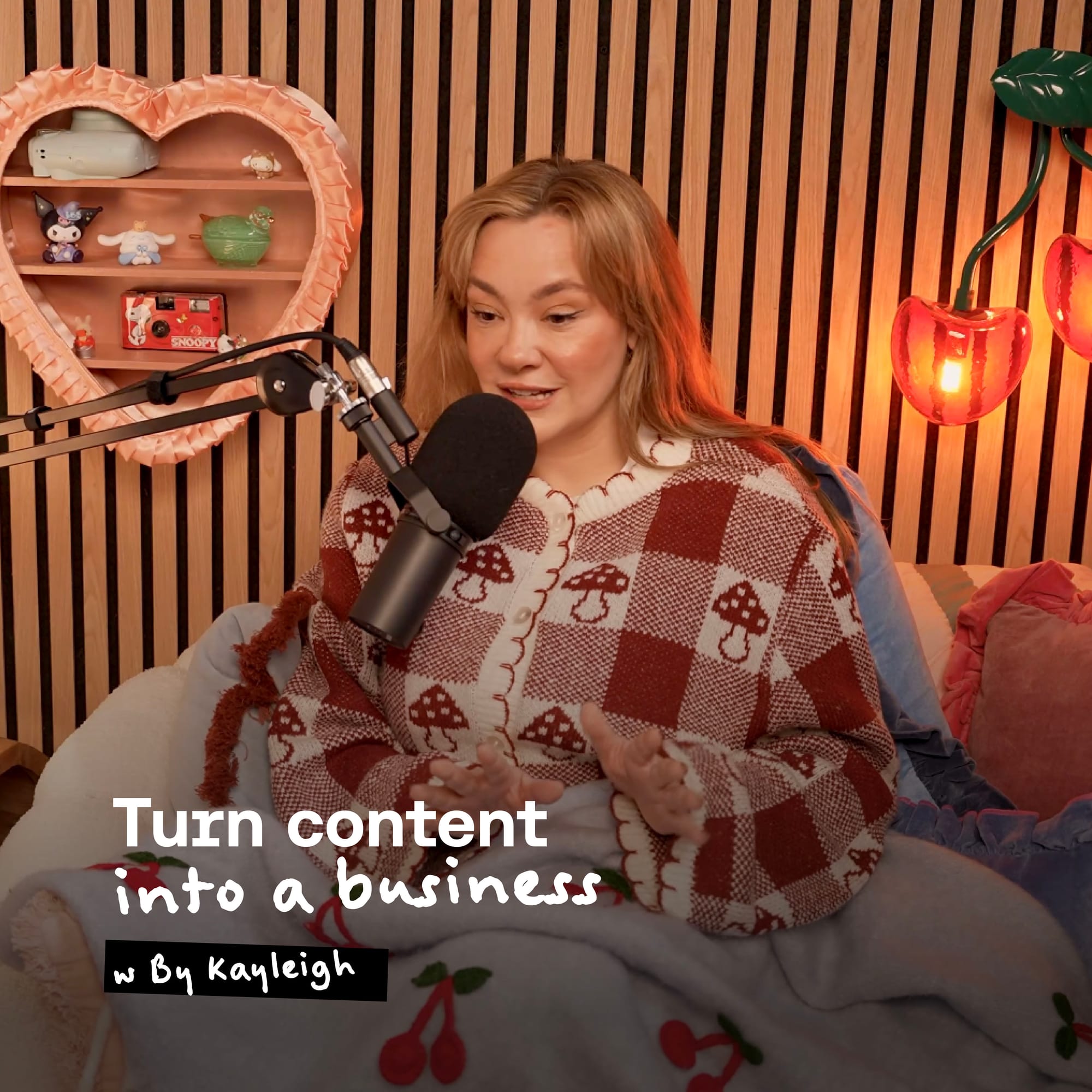
Kayleigh Keen didn't plan to make a business out of content, but she built one anyway. By Kayleigh, now spans a 200+ episode podcast, a YouTube channel, a paid membership she calls her bread and butter, and a coaching business she's spent years refining. It's the kind of diversified setup lots of creators aspire to.
What makes Kayleigh’s story worth hearing is that she never had a masterplan to follow. Kayleigh started out as a working makeup artist who blogged for fun and used Instagram because she had no choice. The business came later, built from a law degree she never expected to use again, a podcast she started because she liked to talk, and a YouTube channel she almost gave up on twice.
In this interview with Uppbeat, Kayleigh explains how her business came together and what she'd tell anyone hoping to turn their content into something that earns a real income.
Podcaster, YouTuber, and business coach Kayleigh Keen is the founder of By Kayleigh. She spent years as a working makeup artist and trained separately as a solicitor, before combining both into the business she runs today, helping other makeup artists and content creators. You can find Kayleigh on YouTube and Instagram, and listen to her podcast on Spotify and Apple Podcasts.
- Start before you have a plan
- Combine the skills you already have
- Give away some of your best work
- Diversify your income, but know which one is home
- Systemize the admin, protect the creative work

1. Start before you have a plan
Before Kayleigh Keen was running a business with a podcast, a YouTube channel, and a paid membership, she was blogging about makeup purely for her own enjoyment. It's tempting to look at a setup like hers today and assume that was her goal from day one, but that wasn’t the case.
Kayleigh: "I started that blog back in 2012 as an outlet of expression. I was just doing makeup, and I thought, is there a way I can share this? I found Blogger, and that's what let me become a full-time makeup artist."
What came next wasn't glamorous either. Kayleigh needed to find clients to work as a makeup artist, and so she turned to Instagram, which quickly became part of the job.
KK: "As a makeup artist, how do you promote your business and get clients? I started on Instagram as soon as it came out; it was just a way of promoting myself. I had to do it, because if you didn't, you wouldn't make money."
For years, posting online was simply the cost of staying in business rather than a deliberate career move.
KK: "I never really thought about making money as a content creator until very recently – maybe the last two years. Before that, it was purely a necessity."
It took a pandemic to turn that necessity into reinvention. When COVID stopped Kayleigh's makeup work almost entirely she was forced to ask what else she could do with the skills she already had. It goes to highlight how Kayleigh’s been able to spot opportunities in challenging situations, rather than following a masterplan.
Kayleigh's Key Takeaway: You don't need a five-year plan to start creating. A reason good enough to keep going – necessity, boredom, or just wanting to share something – is a real enough foundation. The strategy can catch up later.

2. See how you can combine the skills you already have
When COVID left Kayleigh without income from her makeup business, she didn't start mapping out a content strategy. She reached for the qualification she had that most people in her situation didn’t: a law degree.
Kayleigh: "In COVID, I thought, what else can I do? I'd trained as a solicitor and my area was contract law, so I made a humble Etsy shop selling contract templates to other makeup artists."
What looks tidy in hindsight felt much messier while she was living it.
KK: "That journey, from a humble Etsy shop to a podcast to a YouTube channel to talking to you now, wasn't linear. It was one experience leading to the next. All the side quests led me here."
The lesson here is that if something keeps nudging you in a certain direction, it's probably worth following.
Kayleigh's Key Takeaway: The strangest combination of skills on your CV might be your edge. Don't wait for a tidy, linear path to reveal itself. Instead, let the skills you already have combine into something nobody else can offer.

3. Consider giving away some of your best work
Kayleigh started her podcast in 2022, offering savvy tips for people working in the makeup industry. It's since become the foundation of a coaching and membership business that only works thanks to people discovering it through the podcast.
Kayleigh: "My whole coaching and course business was built off my podcast. I've got over 200 episodes of me giving business advice to the makeup niche, and I wouldn't have made a single penny if I hadn't given it away for free."
This is a philosophy she's had to defend more than once. Other creators regularly ask how she can possibly make money while giving so much away. For Kayleigh, her philosophy has proven to be successful.
KK: "People buy from you because, if you're giving something valuable away for free, imagine what they get when they pay."
The return hasn't just been paying members, either. Some of her biggest opportunities have arrived precisely because she refused to hold anything back.
KK: "This week alone I've been asked to interview a celebrity and work on a music video, both off the back of a YouTube video. If I gatekept everything, I wouldn't get these opportunities or make any money."
Kayleigh's Key Takeaway: Gatekeeping your best material to protect a future sale usually backfires. Give away enough that people can see exactly what they'd be paying for – that's what earns the trust that eventually converts into income.

4. Diversify your income, but know which content streams work for you
By the time Kayleigh started YouTube in 2025 – after “trying and failing on and off for two years” – she already had a podcast, a membership, and years of Instagram behind her. What's notable is how differently she treats each one.
Kayleigh: "YouTube I keep very free, very creative. I'm cautious about putting any big strategy over there, because my mind naturally wants to turn everything into a business."
The podcast, by contrast, is where nearly all of her paying members actually come from – even though she's never run an ad on it or sold particularly hard.
KK: "I know pretty much every person in my membership has come from the podcast. But I don't approach it with a sales mindset. I just don't like actually selling to people, and I don't like it done to me."
When a stream stops earning its keep, she doesn't prop it up out of loyalty. She's shut down a makeup artist agency, wound down a course, and is currently closing her photography studio. Crucially, she doesn't treat any of that as failure.
KK: "I built a makeup artist agency and learned I hated being an agent – it was constant admin, so I closed it after a couple of years. My course has naturally run its course. And right now I'm also having tough conversations about my studio, because it costs more than it makes. Some things you don't know until you try them."
Kayleigh's Key Takeaway: Multiple income streams create stability, but only if you're honest about which one is actually making you money. Be equally willing to close the ones that aren't, and treat that as editing the business rather than failing at it.

5. Build a process that protects the creative work
With a podcast, a YouTube channel, a membership, and Instagram all running at once, Kayleigh's calendar looks almost obsessively structured. This is deliberate.
Kayleigh: "Every Sunday I time-block my whole week: scripting, research, filming, editing. It might look insane, but when you have this many income streams, you have to stay on top of it or everything falls apart."
The system runs on more than willpower. She relies on recurring reminders to keep the business moving even when she isn't actively thinking about it.
KK: "I have recurring tasks set up that remind me every week, for example, to do a goal check-in, write a script, or make a thumbnail. I try to systemize everything so my energy goes into the actual job, not the admin."
That structure has paid off in ways beyond productivity. In 2017, an operation left her bedbound for three months, back when she was still purely a makeup artist promoting herself on Instagram.
KK: "I really thought my business would fall apart while I was off. It didn't. Inquiries kept coming in – it was so much more resilient than I thought. Then I went on holiday last year and told my community I'd be out for two weeks. No one cared. They were actually lovely about it! I think a lot of the pressure we put on ourselves isn't even real."
Kayleigh's Key Takeaway: The unglamorous parts – time-blocking, reminders, systems – protect your creative freedom rather than limit it, and let you trust that the business you've built is sturdier than it feels on any given day.

Build a business out of your content side quests
Kayleigh's path wasn't planned in advance, and she'd be the first to say so. What made it work was refusing to wait for a tidy blueprint. She let her skills combine into something new, gave away enough to earn real trust from her audience, and was willing to close what wasn't working without treating it as defeat.
If you want to dig deeper into the tactical side of turning views into income, our conversation with Filmbro's Arnaud Melis on how to make money as a content creator takes a look at how to build a product people are willing to pay for, while our guide to making money on YouTube in 2026 walks through the mechanics of monetizing a YouTube channel from scratch.